Jump directly to content

Small Vibrations

Small Vibrations for Tactile Navigation
Tactility

Human bodies vary in where vibrotactile signals can be sensed and how they elicit emotion. We combine the growing interest in haptic technology, music and vibrotactile communication with new flexible and smart materials in textiles and bioplastics. Our goal is to contribute to the development of sustainable, inclusive and attractive societies

koordinator
Completed
Design Digitalisation System innovation Printed electronics
Region Stockholm
27 månader
200 000
Division: Division Digital Systems and Societal Transformation

In Sweden, there are 1.5 million people with reduced vision and/or hearing to varying degrees, and about 3,000 people with deafblindness. Statistical predictions show that people with disabilities will increase in number in the coming years.

In an inclusive society, tactile articulation and communication can be an accessible information channel. Market forecasts show that one of the fastest growing fields in the global market is haptic  (sensory experiences through skin and body movements) electronics.

The project worked with new technology that enables smaller, more energy efficient and more attractive vibrotactile aids for navigation and detection in varying environments.

Profile image

Contact Elsa

CAPTCHA

* Mandatory 

By submitting the form, RISE will process your personal data.
Profile image

Contact Yusuf

CAPTCHA

* Mandatory 

By submitting the form, RISE will process your personal data.
10. Reduced inequalities
11. Sustainable cities and communities
Funders without URL: Stiftelsen Promobilia Project end date: Sensors and sensor systems Sekundär områdes navigation:
Printed electronics
Design
Textiles
Medtech

Design for circular use

Name of service (page headline, shown in promos – maximum of 70 characters incl. spaces): Design for circular use Lead (include SEO-words and the main benefits for your target groups. Stick to one paragraph, maximum 2-3 sentences):

A circular transition requires changes in user behaviours. But acting in a circular way is challenging; it can be more cumbersome, more time-consuming, and sometimes more expensive compared to the linear alternatives. We can help you design offers that both enable circular use patterns and make them preferable!

Purpose/Benefit:

Today, many people lack preconditions to change their personal life and work life to meet society's sustainability goals and align to strategies for a circular economy. Without changed conditions, it will be difficult for the majority to stop buying newly produced goods and instead start buying, renting, or borrowing things in circular flows and re-circulate them when the time comes. By better understanding users' everyday lives, their circularity-related behaviours, as well as their needs and experience of today's products and services, you will be able to create new circular offerings that enable a circular personal life and work life for more people. Circular offerings based on customer needs also have the potential to both become more attractive than today's linear offerings and contribute to reduced environmental impact. Through this service, RISE helps you explore opportunities for circular offerings with user needs and behaviours in focus.

The service is suitable for companies and organizations that currently develop, renovate, or resell products that can provide clear economic and sustainability benefits if they are circulated in tight loops. Perhaps you offer a product that has a long lifespan without getting paid for the value the product creates over time? Or perhaps you offer a product with a short lifespan that could be redesigned to last longer and be used by more people? Regardless, we can help you explore opportunities for new attractive offers that facilitate circular use patterns.

Method (what/which methods are used to perform the service):

The service is adaptable to your situation. At a first meeting, we talk about your needs, existing customer offerings and challenges. RISE then proposes appropriate activities, which may include, for example:

  • Inspiring lectures on the topic of user-centered circular design.
  • Workshops to create an understanding of the customer's situation and/or develop design concepts.
  • Design sprint where we work through a business opportunity from needs analysis to design solution and business case.
  • User studies that build deeper understanding of the users' situation before workshops or design sprints.

During the activities, RISE introduces concrete and inspiring methods and tools that help you design for circular use patterns with your customers' needs in focus. These help you map processes and customer journeys, explore how users experience circular consumption and reusing products, create concepts based on circular design strategies, and evaluate circular business opportunities.

Delivery (what does the client get after performed service – e.g. a report, certificate etc.):

You will gain a basic understanding of user-centered circular design and how knowledge of the user's personal life or work life can help you develop successful solutions for a circular economy. You will also gain knowledge about how you can work to develop new user-centered circular solutions and what design tools you can use in your process. Depending on the activities carried out, the delivery may also include:

  • Insights about user experiences and user needs.
  • Ideas and concepts for user-centered circular solutions.
  • Business cases for your circular offerings.

Insights and other results can also be compiled by RISE by agreement, for example in a presentation, report or summarised in inspirational scenarios and design fictions or similar. 

Area:
Circular transition
Design
Service innovation
Contact person (Enter one name per field. Activated personal contact pages will appear automatically):
Anneli Selvefors, Senior forskare
Sara Renström, Senior Forskare
Image showing the mapping of circular behaviours
Field measurements: No Price type: 1 Division: Do not use - Division Built Environment Preparation: Description of preparation Preparation information:

The need for preparation varies depending on the activities; we jointly agree on how you can best prepare.

Certification and marking: Not applicable Type of service: Innovation services Instrument: Not applicable General area: Not applicable Order information: For more information and booking contact us. Contact details can be found further down. Divison (OLD): Do not use - Division Built Environment Delivery level: Not applicable
anneli.selvefors@ri.se,sara.renstrom@ri.se
/en/node/9710
9. Industry, innovation and infrastructure
11. Sustainable cities and communities
12. Responsible consumption and production
Purpose - Header: Purpose Metod - Header: Method Delivery - Header: Delivery More information - Header: Mer information
Order
form
Circular transition Sekundär områdes navigation:
Design
Service innovation
Tjänstetyp tagg: Konsultuppdrag

Media production for skills development

Media production
studio

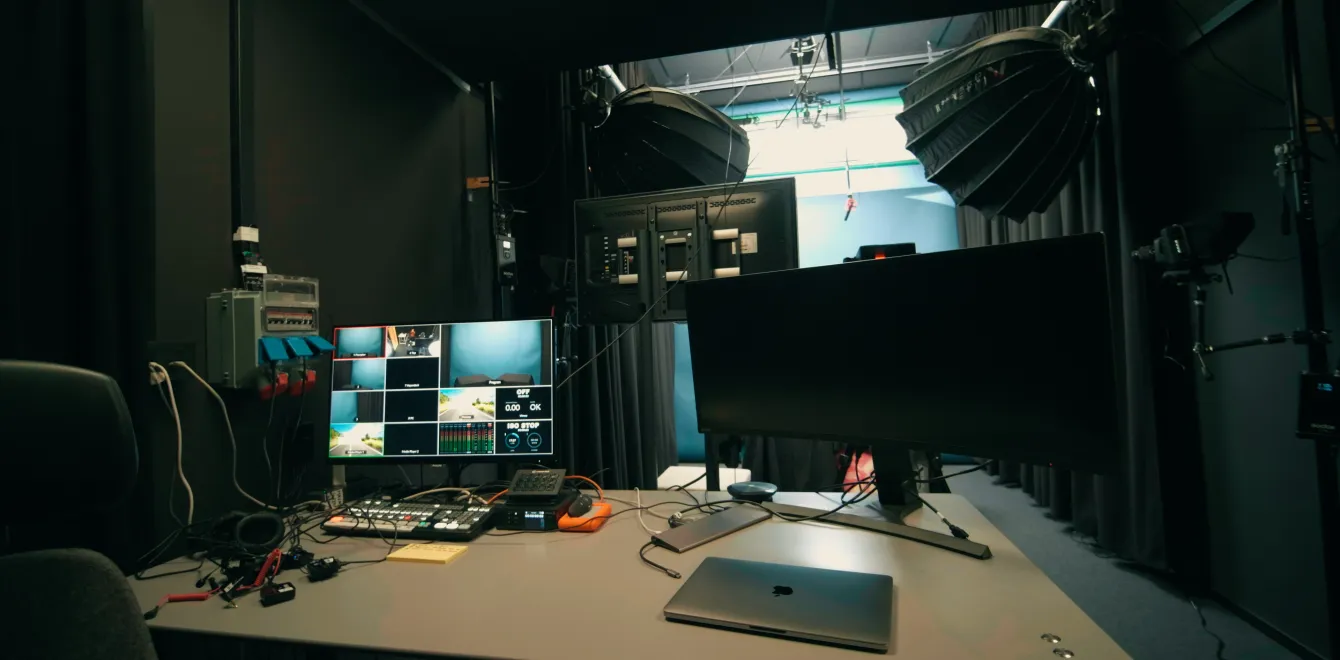
At RISE and the unit Design for all, our expert team in media production for skills development is ready to help you ensure that your messages broadcasts in the best possible way. By using different media, such as sound recordings, films and other formats, our interaction designers and producers work to promote learning, among other things.

Today, there are countless ways to convey messages and spread knowledge, such as producing podcasts, conducting marketing efforts, organizing conferences or creating different types of educations. But adapting the content and ensuring that it reaches the target audience with their individual circumstances in mind is not always easy. This is where we come in and can help.

To enable knowledge enhancement and information dissemination, we are opening up our studio at Lindholmen in Gothenburg. There we can both record and create conditions for live broadcasts of events, lectures or seminars. In addition to assisting with location and technology, we can also help with planning, creating and packaging different types of media content. We can also conduct field visits and make recordings or photo shoots on site or outdoors, to meet your unique needs.

Our media team
Our media team consists of experienced interaction designers, project managers, producers, filmmakers and editors. This means that we can help you through the entire process, from planning education, events or information dissemination to implementation and post-production. Our resources include individuals who can take care of different parts of the project, from script work and storytelling to filming, editing and project management.

Within the team, we have a full stack content creator and experts in storytelling and script work, which means that we can ensure that your productions convey the message you want. We also have specialists who work with filming, editing and live broadcasting, and we can offer support in project management, facilitation and pedagogy. Everything to make the work flow as smoothly as possible and the result to be as good as it possibly can.

Whether you need some of our services or if you want us to take full production and project management responsibility, we are here to help you.

Let us together maximize your opportunities to convey information and spread knowledge in an effective way!


More information:

Are you thinking about disseminating information or creating content for an education?
Do not hesitate to contact us at RISE Design for all.

Contact us: studion@ri.se


Please take a look at what we have done in the past
Media production on Vimeo

Division (OLD): Division Digital Systems and Societal Transformation Division: Division Digital Systems and Societal Transformation Design

Accessibility review

Name of service (page headline, shown in promos – maximum of 70 characters incl. spaces): Accessibility review Lead (include SEO-words and the main benefits for your target groups. Stick to one paragraph, maximum 2-3 sentences):

Accessibility means that all users, with or without disabilities, should be able to access and easily use what you are developing. Without thoughtful design choices, there is a risk of inadvertently excluding people from being able to use a product or service. We help you create accessible design for an inclusive and socially sustainable society. 

Purpose/Benefit:

Using the variation of different people's abilities as a starting point, accessibility helps to include as many users as possible. There are currently EU requirements stating that public authorities' websites, apps and documents must be accessible. Additionally, by 2025 all EU countries must also have legislated that certain products and services within the private sector must be accessible. Through accessibility, competitive products and services are created that are easy to use for all user groups. 

Method (what/which methods are used to perform the service):

We continuously work to create accessible physical and digital environments, products and services. An essential aspect of the work is to include the needs of the user. We do this, among other ways, through interviews, user tests, expert evaluations and workshops, some of which we conduct in the high-tech UX lab. Our methods are well-tested and developed to create a deep understanding of users and their needs. 

We also follow principles for universal design to create environments, products and services that as many people as possible can access and use. Furthermore, we adhere to standards, such as the European standard for digital accessibility, EN 301 549, the Swedish DOS law and WCAG 2.1 which describe guidelines for creating accessible digital products. We base our expert evaluations on these. 

What we do:

  • Evaluation of websites, apps, web content, pdfs and documents in accordance with legal requirements and standards 
  • Evaluations through the involvement of the target group, user testing and expert evaluations 
  • Provide advice and support in design processes, including requirement specification and needs analysis 
  • Create design proposals 
  • Education in accessibility 
Delivery (what does the client get after performed service – e.g. a report, certificate etc.):

Based on our conclusions from reviews, evaluations and analysis, we can deliver a summary to you, with recommendations on how your particular product can be improved and fulfill any legal requirements. This can be a valuable contribution to your future design decisions and further product development. 

High-quality video recordings of user tests in our UX lab coupled with clear summaries can also be delivered. This can provide additional valuable understanding and insight for further development, communication and presentation of your product or service. 

Delivery time:

According to agreement

Area:
Design
Digitalisation
Internet of Things
Public sector
Perception
System innovation
Service innovation
Contact person (Enter one name per field. Activated personal contact pages will appear automatically): Amanda Johnson, Forskare
Computer screen with black background and colorful code
Field measurements: No Price type: 1 Division: Division Digital Systems and Societal Transformation Preparation: No preparation required Standards:

EN 301 549 - Accessibility requirements for ICT products and services


Certification and marking: Not applicable Type of service: Testing / Analysis / Evaluation Instrument: Not applicable General area: Not applicable Order information: Please contact us for further information Divison (OLD): Division Digital Systems and Societal Transformation Delivery level: Not applicable
amanda.johnson@ri.se
/en/node/9710
Purpose - Header: Purpose Metod - Header: Method Delivery - Header: Deliverables More information - Header: Mer information
Request for quote
form
Design Sekundär områdes navigation: Health and life science Tjänstetyp tagg: Verifiering och validering

Usability test with a focus on sustainability

Name of service (page headline, shown in promos – maximum of 70 characters incl. spaces): Usability test with a focus on sustainability Lead (include SEO-words and the main benefits for your target groups. Stick to one paragraph, maximum 2-3 sentences):

Is the product/service perceived as helping the user to make more environmentally friendly choices? The Human Experience unit at RISE has a broad experience of answering questions related to this in usability tests, where the focus is on the user's understanding and behaviour in sustainable choices.

Purpose/Benefit:

The goal is to provide insight into the user's experience and use of the product and how we can use simple means to encourage and facilitate, so-called nudging, a more environmentally friendly use of products and services in our society today.

This can be applied to everything from how the packaging of the product should be recycled, how different words, icons, and explanations are perceived, prompts for how and when the product should be charged and not charged, how much energy the product consumes with different types of programmes and in standby mode, to how the product is best recycled or should be maintained to extend the life of the product.

We start from your needs analysis or help you in the choice of the right method of evaluation and implementation, analysis and compilation of the same.

Method (what/which methods are used to perform the service):

Usability tests

Usability (user-friendliness) can be measured via the ISO standard 9241-11 through efficiency, effectiveness and satisfaction. Based on the same ISO standard and using similar methods, we can measure how clear your eco-friendly features and options are to the user.

In a usability test in our UX Lab, a facility specially designed for usability testing using the latest technology and with usability experts on site, the user performs scenarios that are observed and analysed. For example, we can look at whether the user finds the features that offer more sustainable use and whether the user perceives them as sustainable choices. Other suitable methods for exploring the experience of sustainable features and offers could be field tests, interviews, focus groups or digital surveys. There are many methods and we will help you choose the most effective one to answer your questions based on your needs and process.

Delivery (what does the client get after performed service – e.g. a report, certificate etc.):

Based on our conclusions, we deliver a summary and recommendations on how your product or service can be improved, which is a valuable contribution to decision-making and further development.

High-quality video recordings of the usability tests can be made and then edited into clear summaries, which are useful for further development and for communication and presentation internally to pass on the insights.

Area:
Circular transition
Design
Climate adaptation
Service innovation
Testleader with a protocoll and a testperson in front of a washingmachine
Field measurements: No Price type: 1 Division: Division Digital Systems and Societal Transformation Preparation: No preparation required Standards:

9241-11

Certification and marking: Not applicable Type of service:
Innovation services
Testing / Analysis / Evaluation
Instrument: Not applicable General area: Not applicable Order information: Please contact us for further information Divison (OLD): Division Digital Systems and Societal Transformation Delivery level: Not applicable
kristin.cronzell@ri.se
/en/node/9710
Purpose - Header: Objective Metod - Header: Methodology Delivery - Header: Deliverables More information - Header: Mer information
Request for quote
form
Design Sekundär områdes navigation: Circular transition Tjänstetyp tagg: Provning

Enough!? Exploring sufficient and fair energy use through design

Enough?!
Picture of the project's logo along with the title "Nog?!"

In order to reach energy- and climate goals, we need to understand and apply “sufficiency” – a concept that takes needs, social justice, and planetary boundaries into consideration. But it is difficult for both individuals and organizations to understand what sufficiency is. 

project leader and participant
Active
Design Energy
31 månader
Division: Do not use - Division Built Environment

The project will identify opportunities in striving for sufficiency and social justice through exploring what could be seen as sufficient and fair energy use related to personal needs and interpretations of climate goals. We want to understand the intersection – including synergies and conflicts – between individuals’ and organizations’ experiences of having done enough, understandings of having enough and also what is enough to reach climate goals.

We will develop speculative design objects – so called provotypes – to make visible and challenge norms around energy- and consumption patterns. The insights from the project will be the foundation for a tool that makes visible, explores, and supports energy sufficiency and justice in households and/or organisations. The tool is meant to be a support for energy advisers and similar actors in their work towards e.g., households, and the tool will be designed in collaboration with these actors.

In the longer run, the project wants to highlight the importance of energy sufficiency as a research topic and complement to existing energy research on e.g., energy efficiency. Sufficiency and socila justice can be considered problematic topics to discuss. Therefore, we hope that the project will also contribute to encourage more people to have open discussions about these topics, in order to broaden the discussion about how to achieve a sustainable energy system. Such discussions might also make it easier for future energy policies to include aspects of sufficiency.

The project is funded by the Swedish Energy Agency through their program Design for Everyday Energy Efficiency which is coordinated by SVID. The project partly builds on and extends a previous project on energy resilience, see Designing Everyday Energy Resilience.

The project is a collaboration with Helena Strömberg, Chalmers University of Technology, and Katharina Merl at the product design studio Boid.

August 2025: The resulting handbook on sufficiency from the project is now accessible for download in Swedish! One of the project's design provotypes is also accessible in English here.

Maria Håkansson

Forskare
+46 10 516 55 46 Read more about Maria
Profile image

Contact Maria

CAPTCHA

* Mandatory 

By submitting the form, RISE will process your personal data.
A poster of the Enough donut from the project is available for download!
Attach document:

Poster Enough donut.pdf (pdf, 2.13 MB)

Project end date: Sekundär områdes navigation: Design

Furniture company EFG succeeded in instituting a circular business model

EFG Continue Photo: EFG

How can we combine circularity with a sustainable business model? This was a question that Andreas Mattisson of furniture company EFG had given a great deal of thought to. It was only after chancing on a lecture on future adaptive design by Thomas Nyström of RISE that the pieces began to fall into place. 

Andreas Mattisson, EFG

It all started in 2006, when Andreas Mattisson, head of product development at the Tranås-based European Furniture Group (EFG), began to devote a great deal of time to pondering circular design. While he found the idea very inspiring, no matter how he looked at it, he couldn’t make it add up.

“In a circular economy, even the furniture already sold is considered as a kind of inventory but, if the customer buys a conference table from us and later replaces it with a new table from someone else, who bears the cost for returning the old one? And who are we supposed to sell it to when it’s no longer fashionable? I pondered and pondered, but couldn’t find a solution.” 

Chance takes a hand 

This state of affairs continued until 2020, when Mattisson was invited to an event on circular economy and design arranged by the Furniture Cluster in Tibro. One of the speakers was Thomas Nyström from RISE, who gave a presentation on circular product architecture. This proved to be something of an aha moment for Mattisson. 

“I thought to myself, yes, we could actually work like this! The working method presented by Thomas gave me the key to how I should approach the issue.” 

The concept in question is future adaptive design; although developed by RISE specifically for the furniture industry, it can also be applied to many other product categories. 

“Our assumption is that it is not enough to simply design and manufacture well-made, durable products in quality materials, because people will still tire of them,” explains Nyström. 

“There is significant risk that people will replace furniture before it is worn out, for aesthetic reasons or because they are moving to a smaller office and no longer have space, for example. For whatever reason, the customer’s needs will change over time and so must the product.” 

Instead of replacing the entire piece of furniture, the customer can upgrade

Image: EFG

Layer on layer means you can “keep your darlings” 

In future adaptive design, this problem is solved by viewing product architecture as a number of interacting but interchangeable modules built up in layers to create a whole. 

“Instead of replacing the entire piece of furniture, the customer can upgrade simply by replacing one module and still obtain the desired modernisation,” says Nyström. 

“This means that you can meet the customer’s needs with fewer products, while at the same time the manufacturer receives an income from upgrades and spare parts and society’s overall environmental impact is reduced.” 

In only two years, this mindset has permeated the entire design process at EFG. These days, they talk about “keeping your darlings” through layered design; the design process begins by considering which components the furniture actually consists of. 

“Take a conference table. Basically, it consists of legs, the tabletop and the frame that the tabletop rests on,” says Mattisson. 

EFG then analyses the functions of the furniture to ascertain which are most likely to change, and will change more quickly, in future. 

“In the case of tables, it’s probably the legs, as people’s requirements for table height has changed throughout history. We therefore focus on the legs, giving them a distinct design identity so that, when the table feels old fashioned or is at the wrong height, the customer can replace the legs and will feel that they have a modern and fully functional product again.” 

One solution, many benefits 

To all intents and purposes, these days EFG only manufactures furniture that can be updated as and when needs change. Mattisson sees a number of advantages to this policy. 

“In the long run, we use less raw materials, which is the greatest environmental impact of the furniture industry. It is easier to work with leasing, as an old piece of furniture can easily be adapted to the needs of a new customer. And, when we offer updates with spare parts, we also create closer ties to the customer, as it’s easier for them to buy spare parts from us than to buy brand new furniture from a competitor.” 

FUTURE ADAPTIVE DESIGN 

What is it? Future adaptive design is a working method for designing products adapted to circular business models. 

How does it work? Instead of viewing the product as a whole, it is considered as a collection of modular components assembled to make a product that can adapt to changing needs during its working life. Each layer has a specific function and can be replaced individually. This makes it possible for the customer to replace, alter or upgrade individual components. In this way, the product can be easily adapted to new functional, technical, aesthetic or regulatory requirements, and the customer can achieve the desired modernisation without incurring the environmental impact associated with a brand new product. 

Who is behind it? The concept has been developed by RISE with the aim of connecting circular design to business, production, the environment and behavioural sciences. 

Read more about future adaptive design

EFG 

European Furniture Group (EFG) is one of Europe’s largest suppliers of office furniture to the private and public sectors in the Nordic countries, Europe, the Middle East and Japan. The company’s head office is in Tranås, Småland. EFG has been applying circular design principles since 2020, for the benefit of the company itself, its customers and the environment.

Thomas Nyström

Researcher
+46 73 079 58 21 Read more about Thomas
Profile image

Contact Thomas

CAPTCHA

* Mandatory 

By submitting the form, RISE will process your personal data.
Circular transition Sekundär områdes navigation:
Design
Production and manufacturing
Materials and durability

PLENUM: PLENary multi-User developMent arena for industrial workspace

PLENUM
PLENUM

The core concept of PLENUM is to develop a multi-user platform for collaborative 3D work on factory design, simulation and up-/reskilling for operators which is KPI-based for assessment of sustainability aspects (economic, environmental and social).

Technical Project Leader
Active
Design
36 Months
19 MSEK
Division: Division Digital Systems and Societal Transformation

The platform can be used in a distributed online environment (e.g. in the user’s home or local setting) with a very low barrier to entry, thus decreasing cost of setup, eliminating the need for travel and dedicated training facilities. The developed solution will enable factory layout planning and assessment, collaborative evaluation of layout feasibility with all stakeholders, training opportunities for future equipment handling, heavy and large part installation, robotics interaction (cobot & industrial) all staged in an industrial multi-site collaborative solution.

The solutions developed by the project utilizes state-of-the-art research within XR, cognitive science and computer supported cooperative work for both on-boarding/training in digital factory settings, as well as collaborative work between functions. This contributes to making Sweden an internationally attractive R&D environment. Using this solution, the Swedish industry will be able to effectively re/up-skill their current and future workforce at scale while not being limited by the existing factory space, which is important when implementing frequent changes to and building new production facilities.  The novel technologies and knowledge developed within the project serves as a starting point for future development within the field and is not limited to the industries included in the project. There are great future opportunities for extending the use into other domains (e.g. urban planning, public safety, healthcare and occupational safety and health) thus contributing to increased competitive advantages for the nation.

Asreen Rostami

Senior Researcher
Read more about Asreen
Profile image

Contact Asreen

CAPTCHA

* Mandatory 

By submitting the form, RISE will process your personal data.

Sandra Mattsson

Senior Forskare
+46 10 228 47 62 Read more about Sandra
Profile image

Contact Sandra

CAPTCHA

* Mandatory 

By submitting the form, RISE will process your personal data.
9. Industry, innovation and infrastructure
12. Responsible consumption and production
RISE AB
Project end date: Design Sekundär områdes navigation:
Production and manufacturing
Advanced electronics