Jump directly to content

Methodology for studies of viruses and virucidal effects

Methods for viruses & virucidal effects
The corona virus

The project is expected to strengthen Swedish industry's competitiveness and innovation capacity, as well as society's preparedness in the areas of infection prevention and microbial diagnostics. This will be done by establishing, developing and exploring methodologies for quantifying viruses and mapping virucidal effects from hygiene and cleaning.

Project manager
Active
Infection control Chemical and biological analysis Life Science Food
2021-2023
Division: Division Bioeconomy

Background

Pandemics and outbreaks of infectious diseases are significant threats to the economy and public health in Sweden and globally. In line with the Government's overall goal for COVID-19, both Swedish authorities and companies are working intensively to develop and verify effective products and preventive measures against SARS-CoV-2. The importance of effective action and products against the spread of infection and viruses also extends beyond the current pandemic, for example, Norovirus causes an estimated annual global social cost of $ 60.3 billion.

Needs

All in all, there are both acute and long-term needs for research and method development concerning effective infection control measures against SARS-CoV-2 as well as other disease-causing viruses and future pandemics. Specifically, there is a lack of capacity in Sweden and actors who can meet the industry's need for laboratory work with viruses and virus inactivation. In addition, data for virus inactivation are incomplete or completely missing, which makes risk assessment of virus inactivation very difficult to do reliably, which is needed when evaluating manufacturing processes and products such as biocides.

Methodology

Both cellular and molecular quantitative methods will be applied in the project. Initially, standard methods for laboratory evaluation of virucidal effects (i.e. methods for measuring virus inactivation) should be established and adapted; both model viruses and pathogenic viruses should be used. In addition, methodology for detection and mapping of existing viruses shall be tested exploratively in environments where hygiene products are used. The established methodology must also be able to be used for the production of reliable and supplementary data regarding chemical and thermal inactivation of disease-causing viruses, thereby contributing to future risk assessments being safer and more accurate.

Objectives

Overall, after the implementation of the project, there will be better capacity to meet Swedish industry's needs for studies of viruses and virucidal effects, which promotes the development of effective preventive measures, processes and products. In addition, knowledge about virus inactivation has been strengthened.

3. Good health and well-being
9. Industry, innovation and infrastructure
12. Responsible consumption and production
Project end date: Infection control Sekundär områdes navigation:
Metrology
Risk and security
Chemical and biological analysis

Internal audit for accredited activities

-

Internal audit can be one of the company's most important tools for improvement!

During the course, we cover the basics of audit methodology and how you can plan and carry out internal audits in a good way. We mix the theoretical bases with practical exercises, and the goal is to have a good understanding of how to plan, carry out and monitor an audit in a practical and effective way.

After the physical course, you conduct a small mini-audit at your workplace and then, in a digital follow-up session, we discuss how it went and also address other issues that have come up in the meantime.

We take ISO/IEC 17025:2018 as a starting point, but see that the course is also applicable to other standards. To benefit the most from the course, you should have participated in an audit.

The course is given in Swedish.

Course, In-person,
Course certificate
sv
13-14 oktober 2026 samt digitalt 3 december
RISE - Da Vinci, Brinellgatan 4, Borås - ingång via vår reception
13 Oct 2026 - 14 Oct 2026
15985 SEK (excluding VAT)
20 out of 30
Course
Course certificate
sv
Division: Division Safety and Transport
Margareta Antonsson

Margareta Antonsson

Quality specialist, RISE
Magnus Holmgren

Magnus Holmgren

Konsult, Magnus Holmgren Kvalitetssäkrings AB

Lena Gamalielsson

Administratör
+46 10 516 60 02 Read more about Lena
Profile image

Contact Lena

CAPTCHA

* Mandatory 

By submitting the form, RISE will process your personal data.

Viktoria Jonasson

Projektledare
+46 10 516 56 39 Read more about Viktoria
Profile image

Contact Viktoria

CAPTCHA

* Mandatory 

By submitting the form, RISE will process your personal data.
webid: 37684 categoryid:
217466
237651
267665
309540
358059
413237
Metrology Sekundär områdes navigation:
Innovation management
Service innovation

Test Bed for Purification and Liquefaction of CO₂

Test Bed to purify and liquefy CO₂
TB12 carbon dioxide test bed

With climate change, there is an increased need to capture and take care of carbon dioxide-rich waste streams. Instead of emitting CO₂ into the atmosphere, it can be utilized (CCU) or permanently stored (CCS). The test bed can provide answers to which unit operations are required to produce liquid CO2 (LCO2) of the right quality.

Not applicable
Not applicable

Daniel Tamm

Forsknings- och utvecklingsingenjör
+46 10 516 69 75 Read more about Daniel
Profile image

Contact Daniel

CAPTCHA

* Mandatory 

By submitting the form, RISE will process your personal data.

Erik Fischer

forskare
+46 73 823 46 40 Read more about Erik
Profile image

Contact Erik

CAPTCHA

* Mandatory 

By submitting the form, RISE will process your personal data.
Off
Division: Division Bioeconomy

It is becoming increasingly important to utilize the CO₂ found in flue gases and generated in biochemical processes (e.g. ethanol and biogas production), either for CCU (Carbon Capture and Usage) or for CCS (Carbon Capture and Storage).

Negative Emissions

If the used raw materials are of biogenic origin and the CO₂ is permanently stored, this is called BECCS (BioEnergy with Carbon Capture and Storage) and leads to so-called negative emissions. BECCS and negative emissions are a necessity if we are to be able to reach set global targets for net zero emissions. At Swedish national level, there is a target of capturing and storing 1.8 million tonnes of CO₂ by 2030. The level is then expected to increase to 3-10 million tonnes by 2045. Regardless of which levels are reached in the end, these are large volumes, and new systems are required to be built up in a short time.

Tailor-made Purification

There is a lot of research about capturing CO₂ from flue gases, but very little attention has been paid to subsequent purification in combination with liquefaction of CO₂. This is where our test bed comes in.

The needed degree of purity of the CO₂ product depends on what it is to be used for, and in the case of CCS, extensive purification is required with respect to certain components, e.g. the oxygen content may not exceed 10 ppm, while some other components are not regulated at all. If the CO₂ product is to be used in industry (CCU), other specifications may apply, but regardless of which, the gas needs some type of purification / conditioning after capture from flue gases or from biochemical processes.

With the test bed, we can test and verify the purification of CO₂ flows of different origin and for different applications, in order to reach the specifications set by the end user. This may provide valuable information for investment decisions for upscaling to full scale.

Micro production of liquid CO₂

This pilot plant may also be used as a micro production plant, being able to produce approx. 400 kg of liquid carbon dioxide daily. As such, you can set up at complete, small scale testing environment for your whole value chain of carbon dioxide capture before investing in a full skale plant. You can even fill the liquid carbon dioxide into gas tubes in order to transport it to your business partners.

We Can Come to You

The pilot plant is mobile and placed in a standard 20-foot container, which makes it easy to move around to host plants with different CO₂ streams. It consists of compressor, activated carbon filter, gas dryer, pre-liquefaction chiller, distillation column and buffer storage for liquid CO₂, and can be extended with further purification steps. Product quality is monitored with a gas analyzer (IR and electrochemical sensors) and external analyses as needed.

The test bed is largely automated and is modular so that different unit operations can be bypassed to simplify the purification and be able to purify the CO₂ flow to good-enough quality to be able to lower CAPEX and OPEX in full scale. The test bed is built to be able to process a wide range of gas streams from different sources, which provides high flexibility and enables the operation in conjunction with other test beds, e.g. our test bed for capturing CO₂ (contact Fredrik Weiland).

Process industry
Bioeconomy Biorefinery Energy Fossil free fuels Climate neutral industry
Not applicable
2023
Division (OLD): Division Bioeconomy Bifoga dokument:

Product sheet TB12 (pdf, 564.01 KB)

Fossil-free fuels Sekundär områdes navigation:
Metrology
Production and manufacturing
Energy storage
Chemical products and processes

Training in industrial particle and surface cleanliness (technical cleanliness)

Technical cleanliness

Knowledge and control are very important in the industry today. This is something that RISE, Viverk and FougsTech AB have taken note of. Based on previous trainings and the feedback from its participants, we have now further developed the concept and can now offer an even more initiated education in the area of industrial technical cleanliness.

This training in technical cleanliness, requirements setting, standards, analysis methods, process steps, cleanliness maintenance, and washing technology is conducted in collaboration with Viverk and Fougstech.

The training alternates theory and practice with practical experience from both industry and research. During the training, everything from technical cleanliness, requirements, standards, analysis methods, process steps, maintenance of cleanliness and washing technology is treated.

Together, three market-leading players offer different specializations with the goal of educating you both in depth and breadth.

You are very welcome to get the latest in this exciting topic that can be crucial for large parts of industry and workshops!

Target audience

This training aims for anyone confronted with the quality factor technical cleanliness in their daily work in the automotive sector and suppliers, such as construction, quality assurance, purchasing and sales personnel. Due to the similar cleanliness requirements in the sectors aerospace, hydraulics and precision engineering, this training is also suitable for personnel from these backgrounds. No prior knowledge required. 

Price

SEK 6,500 per participant. When registering two or more participants from the same company, a discount of SEK 1 000 per participant is given from and including participant number two. The price includes lunch, coffee and educational materials.

Language

The course on 27 May 2026 will be held in Swedish.

The course on 21 October 2026 will be held in English.

Others

This course is conducted in collaboration with Viverk and FougsTech. Registration and invoicing are handled by Viverk. All questions regarding registration and invoicing should be directed to Viverk.

Training, In-person,
Swedish
21 October 2026 - Mölndal
RISE Argongatan 30 Mölndal
Map
21 Oct 2026
08:00-16:30
6500 (excluding VAT)
Training
In-person
English
Division: Division Materials and Industry

Boel Pettersson

Researcher and expert, RISE

Researcher and expert in the subject of standards, measurement methods, analysis methods who lectures on the following areas:

Standards (ISO, VDA etc.)
The analysis process
Logistics, storage and assembly
Extended analysis (SEM, LIBS).

Dan Fougstedt

Specialist Technical Cleanliness, FougsTech AB

Specialist Technical Cleanliness with many years of experience in product development from Volvo Cars and Volvo Trucks. Dan Fougstedt lectures on the following areas:

Wear and breakdowns caused by lack of technical cleanliness
Requirements and construction
Maintaining technical cleanliness in production.

Michael Wickell

CEO, Viverk AB

Michael Wickell has extensive experience in the industry and will lecture on and train in washing technology, chemistry, to meet customers' and future requirements in the following areas:

Washing effects
Washing principles
Chemistry
What is possible to achieve, what is the baseline.

Ann-Charlotte Borggren

Administratör
+46 10 228 47 18 Read more about Ann-Charlotte
Profile image

Contact Ann-Charlotte

CAPTCHA

* Mandatory 

By submitting the form, RISE will process your personal data.

Boel Pettersson

Forsknings- och utvecklingsingenjör
+46 10 228 40 38 Read more about Boel
Profile image

Contact Boel

CAPTCHA

* Mandatory 

By submitting the form, RISE will process your personal data.
webid: 45547 categoryid:
230499
241361
241436
254376
268924
268965
Production and manufacturing Sekundär områdes navigation:
Metrology
Materials and durability

Measure heartwood content and relative grain angle of green lumber with Heartwood and Grain Angle On-Line

Name of service (page headline, shown in promos – maximum of 70 characters incl. spaces): Heartwood and Grain Angle On-Line Lead (include SEO-words and the main benefits for your target groups. Stick to one paragraph, maximum 2-3 sentences):

Reduce drying time and improve board shapes by measuring heartwood content and relative grain angle. We help you provide your customers with boards of better quality at a greater profit while saving energy and improving your productivity at the same time.

Purpose/Benefit:

Sorting green lumber by heartwood content and/or grain angle for processing with specially adapted drying methods can vastly reduce drying times and improve board shapes. It also enables new products based on heartwood content.

The system can be used in several ways:

  • To find boards with high or low proportion of heartwood. This is important to achieve a good drying result. The heartwood of pine and spruce has lower moisture content than the sapwood. Consequently, boads with high heartwood content should preferably be dried differently to those with less heartwood content. Board with high heartwood content also have higher durability and are therefore required in some quality classes.
  • To find twist prone boards with a large grain angle. Twisted boards may cause production problems and are also often downgraded, resulting in economic loss. Twist prone boards can be found and also be put in the bottom packages in the kilns to force the boards to remain straight and flat.
  • To separate core boards from outer boards. Core boards and outer boards have different properties, regarding e.g. year ring orientation, knot structure and heartwood content, and can thus be of different use.
Method (what/which methods are used to perform the service):

Heartwood and Grain Angle On-Line are measuring systems based on laser and image processing that can detect heartwood content and grain angle, or both, in one unit during transverse feeding in the sawmill’s green sorting line. The system can work as a standalone unit or be connected to existing automatic green sorting stations, where heartwood content and grain angle are included as grading parameters.

Delivery (what does the client get after performed service – e.g. a report, certificate etc.):

Included when ordering:

  • Installation and commissioning of the system Heartwood and Grain Angle On-Line
  • Introduction for operators in using the system
  • Software in English (or Swedish)
  • Two measuring heads for double sided measuring
  • High performance vision system computer
  • Software licence and remote support for one (1) year
Delivery time:

We can normally deliver within three months after accepted tender, provided that the customer has completed their preparations.

We reserve ourselves against any delay outside of our control, such as, but not limited to, delayed deliveries from our providers.

Area: Production and manufacturing Contact person (Enter one name per field. Activated personal contact pages will appear automatically): Contact for sawmill
Board end with clearly visible heartwood border.
Field measurements: No Price type: 1 Division: Do not use - Division Built Environment Preparation: Description of preparation Preparation information:

The Customer is responsible for:

  • Mounting points for the measuring heads
  • Running cables from the measuring heads to the control room
  • Power and internet connection in the control room
  • Connection to the sorting system

Contact us for full specifications.

Link to order form: sawmill@ri.se Certification and marking: Not applicable Type of service: Not applicable Instrument: Not applicable General area: Not applicable Order information: Request a tender through email: sawmill@ri.se Divison (OLD): Do not use - Division Built Environment Delivery level: Not applicable
sawmill@ri.se,
/en/node/9710
Request for quote
form
Wood technology Sekundär områdes navigation:
Metrology
Sensors and sensor systems
Production and manufacturing
Tjänstetyp tagg: Produkttillverkning

BizWOOD Småland

BizWOOD
Birch in forest

The project aimed to enable the use of Swedish birch as structural timber by developing new grading criteria and demonstrating the material’s potential. As a result, birch can now be classified for load-bearing products thanks to its excellent strength properties, opening up new business opportunities and strengthening the wood industry.

Deltagare
Active
Wood technology
Region Kalmar County
24
3900000
Division: Do not use - Division Built Environment

Project description

Småland is the center of the wood industry in Sweden, and its continued development is important for employment and profitable forestry. The wood industry in Småland mainly consists of small and medium-sized enterprises, many of which have limited opportunities to develop new markets and products. The softwood and hardwood industries have different structures and business models. The softwood industry has a strong and complete value chain and mainly works with standard assortments in large volumes and low margins. The sector is highly export-dependent, and new growth markets in Asia require special efforts to access. The hardwood industry, however, has previously been underdeveloped. Despite broadleaf forests making up 18% and high demand both nationally and globally, most hardwood has been used for pulp production and firewood in Sweden. Nearly all hardwood for the Swedish furniture and interior industry has been imported. The hardwood industry has lacked a functioning value chain—something this project has helped to change.

The project has supported wood industry companies in their development through:

  • Establishing contacts with customer companies in China, Vietnam, and Japan for export development.
  • Developing a sample product for aspen façade panels, including total cost calculations based on manufacturing, installation, environmental requirements, and maintenance.
  • Developing methods for visual grading of Swedish birch into different strength classes, as well as providing data showing that machine grading makes it possible to sort birch into high strength classes for the production of glulam beams in birch or in combinations with spruce and birch.

Subproject 1 was carried out by Region Kalmar, subproject 2 by Träcentrum Nässjö, and subproject 3 by RISE.

Results

The project has shown that Swedish birch has higher bending strength, stiffness, and density than the softwood species currently used in Swedish industry. By developing new grading criteria, both visual and machine-based, the project has paved the way for birch to be used as structural timber, thereby broadening the raw material base of the Swedish forest industry. The results show that a large proportion of the tested birch timber can be classified in high strength classes, opening up new business opportunities and increased use of hardwood. This creates incentives to cultivate and process more broadleaf forests, benefiting the climate, biodiversity, and Sweden’s competitiveness.

Ulf Lemke

Forsknings- och utvecklingsingenjör
Read more about Ulf
Profile image

Contact Ulf

CAPTCHA

* Mandatory 

By submitting the form, RISE will process your personal data.

Marie Johansson

Forskare
+46 10 516 62 51 Read more about Marie
Profile image

Contact Marie

CAPTCHA

* Mandatory 

By submitting the form, RISE will process your personal data.
9. Industry, innovation and infrastructure
12. Responsible consumption and production
15. Life on land
NEW CRITERIA FOR VISUAL STRENGTH GRADING OF SAWN TIMBER FROM BIRCH GROWN IN SWEDEN
Funders without URL:
Europeiska regionala utvecklingsfonden
Region Jönköpings län
Region Kalmar län
Region Kronoberg
Project end date: Wood technology Sekundär områdes navigation:
Production and manufacturing
Biobased materials
Metrology

Force and torque measurement in practice

Force and torque measurement in practice

In all types of measurements, there is a lot to gain if one already has a good idea of which requirements are set on the result and what they are to be used for.

The course aims to provide a better understanding and insight into how force and torque measurement systems work. The course is focused on practical applications and aims to give you more options to choose a suitable measurement system for your application and to realize which limitations your measurement system has.

We present different techniques for force and torque measurement with a focus on practical understanding through lectures and laboratory sessions. We will deal with the interpretation of sensor specifications and how to choose the right transducer and measurement system based on measurement requirements. The course will also include discussion on how to prepare your measurement so that the conditions for a successful measurement are the best. A large part of the course is devoted to practical exercises and discussions about problems and results. Examples of how to carry out a measurement uncertainty analysis are also included.

The course is given in Swedish.

Target audience

Measurement and testing technicians

Course, In-person,
Course certificate
13
sv
24 -25 november 2026
24 Nov 2026 - 25 Nov 2026
19000 SEK (excluding VAT)
30 out of 30
Course
13
Course certificate
sv
Division: Division Safety and Transport
Mikolaj Wozniak

Mikolaj Wozniak

Engineer, RISE, Measurement Science and Technology
Maahir Cusmaan Cumar

Maahir Cusmaan Cumar

Engineer, RISE, Measurement Science and Technology

Lena Gamalielsson

Administratör
+46 10 516 60 02 Read more about Lena
Profile image

Contact Lena

CAPTCHA

* Mandatory 

By submitting the form, RISE will process your personal data.

Mikolaj Wozniak

TIC- ingenjör
+46 10 516 62 07 Read more about Mikolaj
Profile image

Contact Mikolaj

CAPTCHA

* Mandatory 

By submitting the form, RISE will process your personal data.
webid: 35917 categoryid:
229266
265461
309533
358084
420168
Metrology Sekundär områdes navigation: Production and manufacturing

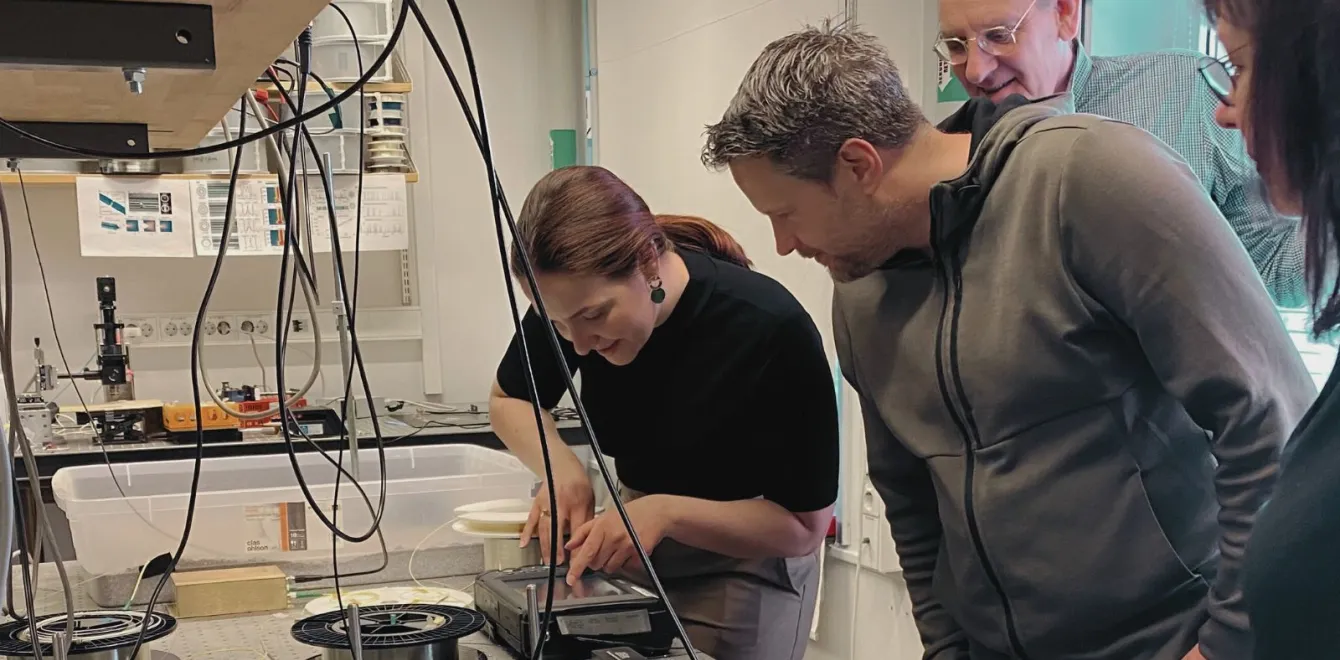
Hands-on training course: Fiber optic sensors and specialty optical fibres for applications in industry

Fiber optic sensing Training course

Curious to know how fiber optics can be used as sensors in industry? In this full day course, we demonstrate how fiber optic sensors are used in industry, and how custom optical fibers makes a difference.

Fiber optic sensors are used in demanding environments across various industries. In many cases, custom-designed optical fibers—known as specialty optical fibers—are required for specific applications.

Course Content

The goal of this course is to provide a practical demonstration of how fiber optic sensors work and to offer insight into how they can enable new products and industrial applications.

  • How do fiber optic sensors work?
  • What are the most common sensor types and applications?
  • Why does the choice of optical fiber matter?
  • Demonstration of common sensors and hands-on experimentation with the systems.

The day includes lectures, Q&A sessions, and lab demonstrations. You’ll gain a deeper understanding of fiber optic sensors and the critical factors to consider when designing a sensor for a specific application.

This training is organized as part of the EU project PhotonHub.

Related: (webinar) Fiber Optic Sensing and Specialty Fibers: Technologies and Industrial Applications

Join us for training in fiber optic sensing

Sign up for the course

The course is held in English, on site at the RISE laboratories in Kista/Stockholm. The course can accommodate a limited number of participants.

Pls register via the 'Registration link' on this page. 

Contact us for more information.  

Who should attend?

The course is intended for development engineers and business developers who are curious to know how fiber optics can be used in industrial applications.

A basic knowledge of fiber optics is preferred but not necessary.

Related: 2 hour free webinar on fiber optic sensing. This short webinar is a perfect background, but not required to benefit from the full day training. 

Read more about RISE exertise and resources in 

Demo, In-person,
8
English
Photonhub Fiber Optic Demo
Isafjordsgatan 22 Kista Sweden
Map
21 Oct 2026
09:00-17:00
Free for industrial participants (excluding VAT)
In-person
8
English
Division: Division Digital Systems and Societal Transformation

Preliminary program:

09-9.30, Introduction, short visit to RISE facilities

09.30-10.30: Course: Fiber sensing basics and examples
Design parameters and fabrication of specialty optical fibres. Fiber optic sensing and sensor applications. 

Fika / coffee

10.45–11.30: Hands-on in the lab: Optical fibre handling

11.30–12.15: Case study 1: Fiber coating for sensing in harsh environments
Hands on in the lab: Distributed Temperature Sensing in high-voltage environment

12.15-13.30: Lunch

13.30-14.15: Case study 2: Asset monitoring 
Hands on in the lab: Strain/shape mapping with FBGs

Fika / coffee

14.30–15.15: Case study 3: Vibration measurements using thin optical fibre cables
Hands on in the Lab: Distributed (phase) Optical Time domain Reflectometry (DAS)

15.30-17.00: Follow-up questions, discussions, and close

Åsa Claesson

Read more about Åsa
Profile image

Contact Åsa

CAPTCHA

* Mandatory 

By submitting the form, RISE will process your personal data.
Fiber optics and photonics Sekundär områdes navigation: Metrology

Diplomerad lufttäthetsprovare

Lufttäthet - Blower door

Denna utbildning riktar sig till dig som utför lufttäthetsprovningar av byggnader enligt SS‑EN ISO-9972:2015 och vill visa för din uppdragsgivare att du har kompetens att utföra provningen korrekt.

Du kommer under denna utbildning få förståelse för hur man i byggprocessens olika skeden kan arbeta för god lufttäthet. 

Utgångspunkten är "Branschstandard ByggaL - Metod för byggande av lufttäta byggnader." 

Målgrupp

Utförare av lufttäthetsprovningar av byggnader.

Förkunskapskrav

Deltagaren ska inför kursen ha:

  • Mätteknisk kunskap
  • Byggteknisk kunskap – kunskap om konstruktioner och byggprocessen (högskoleingenjörsexamen eller minst 5 års erfarenhet från byggsektorn inom projektering eller produktion)
  • utfört/deltagit i minst fem lufttäthetsprovningar med luftläckagesökning vilket ska verifieras genom att rapporter från dessa skickas in till oss före utbildningens start. Deltagarens namn ska finnas angivet i rapporten (uppdragsgivare kan maskeras

Föreläsare

Föreläsare är flera experter vid RISE, däribland Owe Svensson, Thorbjörn Gustavsson, Peter Ylmén och Richard Dawson,  samt Paula Wahlgren från Dovii Consulting & Education AB.

Övrig information

Deltagaren behöver ha tillgång till lufttäthetsprovningsutrustning (fläktutrustning med tillbehör) och utrustning för luftläckagesökning (t ex lufthastighetsmätare och värmekamera) samt behärska dessa. Utrustningen tas med och används vid det praktiska provet

Deltagaren behöver dessutom inneha ett eget exemplar av standarden SS-EN ISO 9972:2015

Utbildning, Fysiskt,
Diplomering
Svenska
Borås 25-26 november 2026
Brinellgatan 4 Borås
25 Nov 2026 - 26 Nov 2026
08:15-17:00
25000 SEK (excluding VAT)
15 out of 15
Training
Diploma granting
Svenska
Division: Använd ej - Division Samhällsbyggnad
Thorbjörn Gustavsson

Thorbjörn Gustavsson

RISE
Owe Svensson

Owe Svensson

RISE
Peter Ylmén

Peter Ylmén

RISE
Richard Dawson

Richard Dawson

RISE

Paula Wahlgren

Dovii Consulting & Education AB

Utbildningsprogram dag 1:

  • Varför ska man bygga lufttätt?
  • Rollen som Diplomerad Lufttäthetsprovare
  • Lufttäthetsprovning
    • Standarden SS-EN ISO 9972:2015 och branschstandard ByggaL
    • Definition och beräkning av omslutningsarea
    • Metodval
    • Sektionering vid provning
    • Mottryck
    • Praktiska tips, tolkningar, felkällor
    • Alternativa provningsprogram (förinspelad videoföreläsning)
  • Var sker luftläckagen och hur bygger man lufttätt?
    • Principer för att bygga lufttätt (fokus på byggskedet)
    • Lufttäthetsklassning av fönster och dörrar
    • Beständighet
    • Krav och kriterier i byggreglerna och frivilliga klassningssystem


Utbildningsprogram dag 2:

  • Branschstandard ByggaL
  • Ritningsgranskning
  • Praktisk genomgång av lufttäthetsprovning och luftläckagesökning
  • Teoretiskt prov

Praktiskt prov genomförs i Borås vid separat tillfälle där deltagaren har med sig egen utrustning för täthetsprovning och luftläckagesökning.

Emelie Gäskeby

Kundsupportadministratör
+46 10 516 69 62 Read more about Emelie
Profile image

Contact Emelie

CAPTCHA

* Mandatory 

By submitting the form, RISE will process your personal data.

Thorbjörn Gustavsson

Gruppchef
+46 10 516 52 79 Read more about Thorbjörn
Profile image

Contact Thorbjörn

CAPTCHA

* Mandatory 

By submitting the form, RISE will process your personal data.
emelie.gaskeby@ri.se
webid: 45313 categoryid:
229343
261600
295146
339091
339091
399895
447247
Byggd miljö Sekundär områdes navigation:
Metrologi och mätteknik
Klimatanpassning

Certification according to OEKO-TEX® LEATHER STANDARD -Products and accessories tested for harmful chemical substances

Name of service (page headline, shown in promos – maximum of 70 characters incl. spaces): OEKO-TEX® LEATHER STANDARD Product certification for leather Lead (include SEO-words and the main benefits for your target groups. Stick to one paragraph, maximum 2-3 sentences):

OEKO-TEX® LEATHER STANDARD is a certification for leather products and accessories that have been tested for harmful substances. Ready to get started on certifying your leather products? RISE is the official OEKO-TEX® institute for Sweden and Norway, and also certifies OEKO-TEX® LEATHER STANDARD in the Baltic countries and Finland.

Purpose/Benefit:

OEKO-TEX® LEATHER STANDARD

An OEKO-TEX® LEATHER STANDARD certification means that the product meets high human-ecological requirements, i.e. does not contain chemicals at levels harmful to health. The certificate can be the key to new business partnerships, as the criteria for OEKO-TEX® LEATHER STANDARD often form the basis for restricted substance lists (RSL) used by retail chains, manufacturers, etc.

OEKO-TEX® LEATHER STANDARD was introduced in 2017 and companies in more than 100 countries across the entire textile supply chain participate in the certification system, with over 100 valid certificates currently in existence.

Method (what/which methods are used to perform the service):

Certification from fiber to Product

Leather and leather articles from all processing levels can be certified: from semi-finished leather products to finished articles. This includes leather fiber materials, leather clothing, leather accessories such as e.g. leather gloves, leather bags and leather shoes and also leather (e.g. sheepskin, lambskin, cowhide). We do not certify the leather from exotic or protected animals such as crocodiles, snakes and armadillos. We test textile or non-textile components in a leather article in accordance with the criteria in the current STANDARD 100 of OEKO-TEX®.

The tests are only performed at one of the prestigious and renowned textile research and test institutes connected to the OEKO-TEX® Association. RISE is the only institute in Sweden and Norway authorized to certify according to OEKO-TEX® LEATHER STANDARD.

Test criteria

OEKO-TEX®  LEATHER STANDARD does not only include substances that are banned or that have legally established limits, but also includes other substances that have been scientifically proven or are suspected to have adverse health effects.
Examples of parameters that are included in  OEKO-TEX® LEATHER STANDARD are prohibited azo dyes, carcinogenic and allergenic dyes, phthalates, formaldehyde, pesticides, heavy metals, perfluorinated compounds, organic tin compounds, biologically active products, and flame-retardant materials etc.

The parameters included in the requirements are based on:

  • Legally prohibited and controlled substances (REACH related and CPSIA-adapted regarding lead.
  • Substances that may be harmful to health.
  • Product quality
  • Biologically active substances and flame retardants (according to an "approved" list).

Product classes

In order for the limits values to be relevant for different types of products, there are four different types of product classes based on the certified product's intended area of use:

  • Product Class I – Products for children up to 3 years
  • Product Class II – Products that mostly come in direct contact with skin
  • Product Class III – Products which do not come in contact with the skin, or do so only to a small extent
  • Product Class IV – Furnishing and decorative materials

Type of certificates

  • Standard certificate, annex 4 & 5
  • Special articles
  • Special articles PPE
  • Comission dyeing- finishing certificate
  • Marketing certificate
Delivery (what does the client get after performed service – e.g. a report, certificate etc.):

A OEKO-TEX® LEATHER STANDARD certificate with related test report. The certificate is valid for one year.

Delivery time:

In case of quotation request

Area:
Certification
Product safety
Contact person (Enter one name per field. Activated personal contact pages will appear automatically):
Helena Hjärtnäs, Forsknings- och utvecklingsingenjör
Ingegerd Hartmann, Forsknings- och utvecklingsingenjör
OEKO-TEX Leather standard
Field measurements: No Price type: 1 Division: Division Materials and Industry Preparation: Description of preparation Preparation information:

Fill in an application by clicking the button above or by reaching out to us and we will guide you.

Our OEKO-TEX® LEATHER STANDARD experts

Complaints and feedback regarding OEKO-TEX®

Do you have views on our work with OEKO-TEX® certifications, on the OEKO-TEX® standards, or on RISE as a member institute of OEKO-TEX®? We welcome your feedback via the complaint form on the OEKO-TEX® website.

Standards:

OEKO-TEX®  LEATHER STANDARD

Certification and marking: Certification of Textiles Type of service: Certification Instrument: Not applicable General area: Not applicable Order information: Please order via the contact persons listed below URL: Om LEATHER STANDARD by OEKO-TEX® Divison (OLD): Division Materials and Industry Delivery level: Not applicable
helena.hjartnas@ri.se,ingegerd.hartmann@ri.se
Documents:

Factsheet (pdf, 96.89 KB)


Application (pdf, 5.2 MB)


3. Good health and well-being
12. Responsible consumption and production
Purpose - Header: What is OEKO-TEX® LEATHER STANDARD? Metod - Header: How does it work?
Application
link
Textiles Sekundär områdes navigation:
Metrology
Health and life science
Tjänstetyp tagg: Certifiering