Jump directly to content

Distribuerad fukt- och läckageövervakning av byggnader

Fukt och läckageövervakning av byggnader

Syftet med projektet var att utvärdera den tekniska, praktiska och kommersiella genomförbarheten av en innovativ idé och metod för fukt- och läckagemätning med distribuerad fiberoptisk sensorteknik. Tekniken har potential att kunna övervaka över stora ytor och längder i byggnader och konstruktioner på ett mycket kostnadseffektivt sätt.

Koordinator/Projektledare
Completed
Fiberoptik och fotonik Sensorer och sensorsystem
4 månader
574 590
Division: Division Digitala system och samhällsomställning

Målet med projektet var att påvisat teknisk och kommersiell tillämpbarhet för en innovativ idé för fukt- och läckagemätning över långa längder och stora ytor i träbyggnader. Idén baseras på en smart kabeldesign där den optiska förlusten i kabeln gö rs känslig för fukt eller
vatteninträngning. Projektet har unde rsökt en prototyp i labbmiljö och kommit fram till att tekniken är lämplig. Dock fann vi även att att sensorkonceptet i nuläget inte är kommersiellt tillämpbart inom träbyggnadsbranchen.

Resultaten från labbförsöken visar entydigt att det är möjligt att detektera vatten. Genom att använda en Raman-OTDR har det även vistas att det är möjligt att loka lisera var vatten är i kontakt med sensorn. Genom att visa på att förlu sterna i sensorn inte beror nämnvärt på ljussignalens våglängd har vi visat att det är fritt att använda kommersiellt tillgängliga lågkostnadsljuskällor och detektorer.

Vi utredde behoven av en fibersensor i träbyggnadskonstruktioner genom besök på byggen men då behoven av en distribuerad mätteknik bedömdes som ringa inom träbyggnadsbranchen i nuläget gjordes inga fortsatta ansträngningar att utveckla koncept för installation. Utvecklingen av och testningen av en sensor i labbmiljö indikerar att fortsatt utvec kling av sensorn, eventuellt med fokus på detektion av andra ämnen än vatten, är mycket lovande.

Project end date: Träteknik Sekundär områdes navigation:
Fiberoptik och fotonik
Metrologi och mätteknik
Sensorer och sensorsystem

Fiberoptisk fuktsensor för ökad digitalisering av transformatorer

Fiberoptisk fuktmätning i transformator
Transformator

Hälsotillståndet hos en transformator påverkas starkt av fukthalten i oljan och framförallt isolermaterialet runt lindningarna. Dagens mätmetoder ger endast ett medelvärde för hela transformatorns oljevolym. Fukten är emellertid inte jämnt fördelad. Genom att mäta direkt på isoleringen med en fiberoptisk sensor fås ett mer relevant mätvärde.

Koordinator
Completed
Fiberoptik och fotonik Digitalisering
Ej tillämpbart
7 månader
800 000 SEK
Division: Division Digitala system och samhällsomställning

Ett mål var att undersöka genomförbarheten av en fiberoptisk mätning av fukthalten i transformatorisolering vilket gjorts och slutsatsen är att en noggrannhet på bråkdelen av en procent är möjlig. Vi undersökte ocks å undersöka värdet och användningen av data från en sådan mätning. Genom att välja rätt sensorplacering kan modelleringen av transformatorn förbättras och på så vis kan tidigare varningar för potentiella problem erhållas. Ett tredje mål var att lägga en plan för fortsatt utveckling vilket gjorts och vi undersöker nu i
vilken form planen bör genomföras.

Resultaten från förstudien visar att det är både möjligt och motiverat att fortsätta utvecklingen mättekniken. Det är förväntat att detta leder till en implementerbar fuktmätning som kan förbättra modeller och bidra till bättre underhållsplanering av transformatorer och på sikt även en  förbättrad utformning av transformatorerna.

Arbetet har skett i samarbete mellan RISE och Hitachi Energy. RISE har utfört huvuddelen av den tekniska evalueringen, tex de spektroskopiska mätningarna. Hitachi som vill implementera tekniken har bidragit med analys om var mätningar är mest relevanta, hur datan kan användas, kravbild, samt provpreparering.

Kenny Hey Tow

Gruppchef *
+46 10 228 41 24 Read more about Kenny
Profile image

Contact Kenny

CAPTCHA

* Mandatory 

By submitting the form, RISE will process your personal data.
7.Hållbar energi för alla
Project end date: Energiöverföring Sekundär områdes navigation:
Fiberoptik och fotonik
Metrologi och mätteknik
Sensorer och sensorsystem
Digitalisering

(webinar) Fiber Optic Sensing and Specialty Fibers: Technologies and Industrial Applications

Fiber optic training PhotonHub

In this short course, you will be introduced to Fiber optic sensing and its applications in Industry and Manufacturing. You'll learn about the optical fibers that enable the sensors, and how to design them for your requirements. You'll also learn about the PhotonHub project and the offers available for developing next generation fiber products.

You'll find photonics almost everywhere, from cameras and traffic lights to within advanced medical equipment and telecom systems. The technologies inside the systems differ, with the common denominator that photons are used to bring intelligence to the systems. 

Course content 

The course will give a comprehensive overview of fiber optic sensor technologies and applications, and the specialty optical fiber that enables the sensors. The training provides an open forum for attendees to ask questions to experts in the field of fiber optics and a wide range of application areas.

The course also gives an overview of technical and business support measures provided by PhotonHub Europe and other photonic initiatives in the European ecosystem.

Related: Full day hands-on demonstraton course in fiber optic sensing.

Who should attend?

The course is intended for those curious to learn about fiber optic sensing and specialty optical fibers in general, and the opportunities the technology brings. If you are a technology- or business developer, and you want to get an overview over the area, this webinar is for you!

Sign up for the course

The training is offered within the framework of the EU project PhotonHub. The course is held in English, on-line via Teams, from the RISE laboratories in Kista/Stockholm and Hudiksvall.

Registration is done via the link on this page.

Contact us for more information.

Web based, Digital - live,
2
English
Photonhub Fiber-intro autumn 2027
21 Sep 2027
09:00-11:00
No charge (excluding VAT)
Web based
Digital - live
2
English
Division: Division Digital Systems and Societal Transformation

Åsa Claesson

Read more about Åsa
Profile image

Contact Åsa

CAPTCHA

* Mandatory 

By submitting the form, RISE will process your personal data.
Fiber optics and photonics Sekundär områdes navigation:
Sensors and sensor systems
Lifelong learning
Medtech
Production and manufacturing

Introduction to Nanophotonics - technologies and applications in Sustainable Environment & Energy

Nanophotonics

Are you curious to learn what Photonics is and how it is used? In this short course, you will be introduced to nanophotonic technologies and their applications in Energy and Sustainable environment. The course will also describe how you can benefit from the European network PhotonHub Europe, for technology and business development in the field.

You'll find photonics almost everywhere, from cameras and traffic lights to within advanced medical equipment and telecom systems. The technologies inside the systems differ, with the common denominator that photons are used to bring intelligence to the systems. 

Course content 

The course will give a comprehensive overview of nanophotonics technologies and applications. The training provides an open forum for attendees to ask questions to experts in the field of nanophotonic technologies and a wide range of application areas.

The course also gives an overview of technical and business support measures provided by PhotonHub Europe and other photonic initiatives in the European ecosystem.

Who should attend?

The course is intended for those curious to learn about nanophotonics in general, and the opportunities the technology brings. If you are a technology- or business developer, and you want to get an overview over the area, this short course is for you!

Sign up for the course

The training is offered within the framework of the EU project PhotonHub. The course is held in English, on-line via zoom, from the RISE laboratories in Kista/Stockholm.

Registration is done at PhotonHub's website, direct link to the registration via the 'Registration' button on this page.

Contact us for more information.

Web based, Digital - live,
2
English
Preliminary date
Digital
17 Mar 2027
09:00-11:00
No charge (excluding VAT)
Web based
Digital - live
2
English
Division: Division Digital Systems and Societal Transformation

Qin Wang

Senior Expert
+46 10 228 41 29 Read more about Qin
Profile image

Contact Qin

CAPTCHA

* Mandatory 

By submitting the form, RISE will process your personal data.
Sekundär områdes navigation:
Fiber optics and photonics
Digitalisation

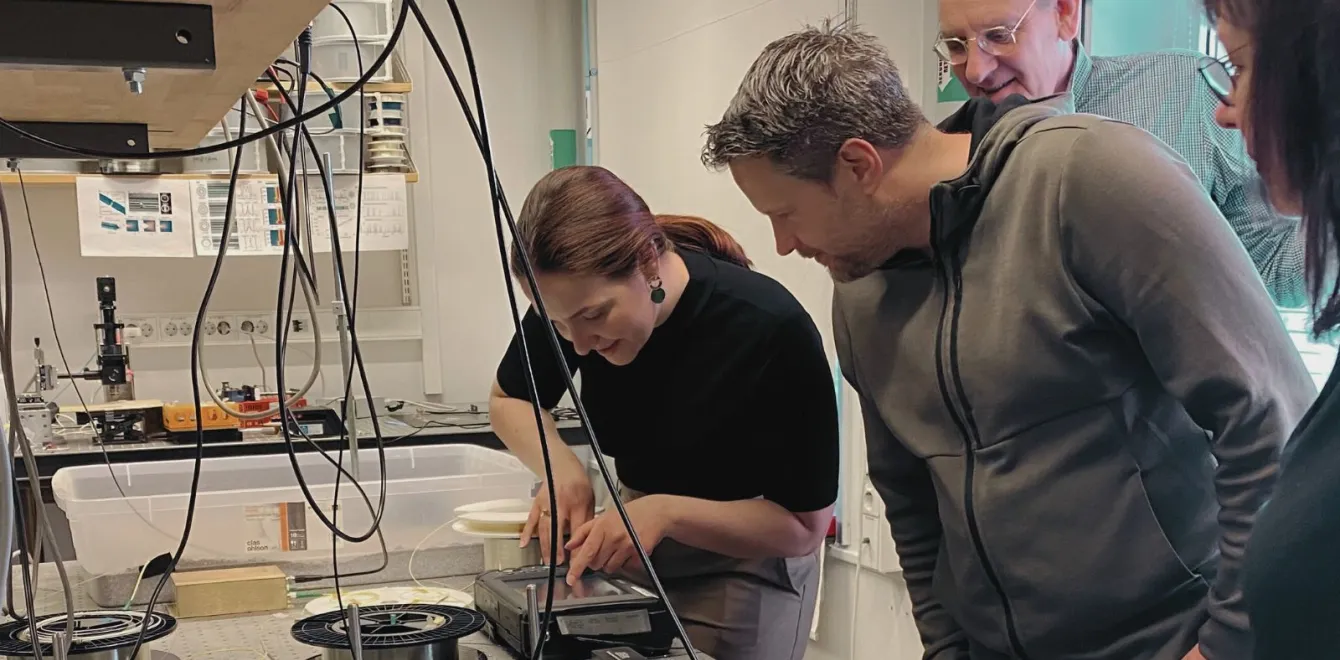
Hands-on training course: Fiber optic sensors and specialty optical fibres for applications in industry

Fiber optic sensing Training course

Curious to know how fiber optics can be used as sensors in industry? In this full day course, we demonstrate how fiber optic sensors are used in industry, and how custom optical fibers makes a difference.

Fiber optic sensors are used in demanding environments across various industries. In many cases, custom-designed optical fibers—known as specialty optical fibers—are required for specific applications.

Course Content

The goal of this course is to provide a practical demonstration of how fiber optic sensors work and to offer insight into how they can enable new products and industrial applications.

  • How do fiber optic sensors work?
  • What are the most common sensor types and applications?
  • Why does the choice of optical fiber matter?
  • Demonstration of common sensors and hands-on experimentation with the systems.

The day includes lectures, Q&A sessions, and lab demonstrations. You’ll gain a deeper understanding of fiber optic sensors and the critical factors to consider when designing a sensor for a specific application.

This training is organized as part of the EU project PhotonHub.

Related: (webinar) Fiber Optic Sensing and Specialty Fibers: Technologies and Industrial Applications

Join us for training in fiber optic sensing

Sign up for the course

The course is held in English, on site at the RISE laboratories in Kista/Stockholm. The course can accommodate a limited number of participants.

Pls register via the 'Registration link' on this page. 

Contact us for more information.  

Who should attend?

The course is intended for development engineers and business developers who are curious to know how fiber optics can be used in industrial applications.

A basic knowledge of fiber optics is preferred but not necessary.

Related: 2 hour free webinar on fiber optic sensing. This short webinar is a perfect background, but not required to benefit from the full day training. 

Read more about RISE exertise and resources in 

Demo, In-person,
8
English
Photonhub Fiber Optic Demo
Isafjordsgatan 22 Kista Sweden
Map
21 Oct 2026
09:00-17:00
Free for industrial participants (excluding VAT)
In-person
8
English
Division: Division Digital Systems and Societal Transformation

Preliminary program:

09-9.30, Introduction, short visit to RISE facilities

09.30-10.30: Course: Fiber sensing basics and examples
Design parameters and fabrication of specialty optical fibres. Fiber optic sensing and sensor applications. 

Fika / coffee

10.45–11.30: Hands-on in the lab: Optical fibre handling

11.30–12.15: Case study 1: Fiber coating for sensing in harsh environments
Hands on in the lab: Distributed Temperature Sensing in high-voltage environment

12.15-13.30: Lunch

13.30-14.15: Case study 2: Asset monitoring 
Hands on in the lab: Strain/shape mapping with FBGs

Fika / coffee

14.30–15.15: Case study 3: Vibration measurements using thin optical fibre cables
Hands on in the Lab: Distributed (phase) Optical Time domain Reflectometry (DAS)

15.30-17.00: Follow-up questions, discussions, and close

Åsa Claesson

Read more about Åsa
Profile image

Contact Åsa

CAPTCHA

* Mandatory 

By submitting the form, RISE will process your personal data.
Fiber optics and photonics Sekundär områdes navigation: Metrology

Fast and non-contact chemical analysis - UVF

Fast and non-contact chemical analysis - UVF

UVF (Ultraviolet Fluorescence Analysis) is a non-contact method for the detection of biological materials, such as oil. RISE develops UVF systems that are adapted to challenging applications.

Optical analysis using fluorescence in the ultraviolet part of the spectrum (UVF) is a well-known method that is particularly suitable for the detection of biological substances. Trace amounts of oil is one common substance where UVF is used.

Ultraviolet fluorescence analysis

The UVF technology is relatively simple in theory: a sample is illuminated with UV radiation. The sample is first absorbing the light (excited) and then emitting light (emission via fluorescence). The fluorescence is detected and analysed. 

The fluorescence is shifted towards longer wavelengths than the incident light, which makes it easier to separate scattered light from the light source from the fluorescence being measured.

Sensors based on UVF have been developed since the 1970s and there are commercial instruments on the market. The technology is characterized by a high sensitivity, but a complication is that common biological substances such as bacteria and algae have fluorescence spectra that can overlap with spectra of the substance that you want to detect. UVF instrumentations therefore need to either have narrow specifications on the type of water or other media in which they operate effectively, or allow multispectral detection, ie emission detection and / or excitation takes place at a number of different adjustable wavelengths.

In its most general form (a so-called fluorometer), a UVF instrument becomes expensive and less suitable as an autonomous sensor in the field. This means that a product for a specific application area can often not be used for another.

Tailor-made systems for analysis directly in processes

RISE develops tailor-made systems based on multispectral UVF for analysis for field use, e.g. to detect oil in water. The development takes place together with the metal research institute Swerim.

UVF can provide a relatively high sensitivity (e.g. micrograms of oil per liter of raw water) and can also be used for distinction between different substances, if accurately  calibrated. In many cases, several spectrum are needed to ensure a reliable result. The technology is also very interesting for 'early warning systems' and to indicate is a process or sample volume needs further investigation and / or immediate action.

RISE' systems are built to contribute to the digitalisation of the processes involved. We strive for non-contact measurements that are:

  • continuous,
  • connected to the system, and
  • used inline in the production flow.

The generic UVF technology at RISE is adapted to the customers' area of ​​application and packaged in robust prototypes that can be evaluated in the field for further product development.

RISE system for UVF

Schemagic description of the UVF system at RISE

The basic components included in the RISE UVF system are shown in the picture: excitation takes place with a replaceable UV-LED and detection of the emission is done via a monochromator. The analysis system can be set to filter any wavelength in the ultraviolet and visible part of the spectrum.

Where do you need to measure?

Contact us to discuss more about what UVF can do for your particular application!

Ingemar Petermann

Forskare
+46 70 768 77 27 Read more about Ingemar
Profile image

Contact Ingemar

CAPTCHA

* Mandatory 

By submitting the form, RISE will process your personal data.

Björn Norberg

Affärsutvecklare
+46 10 228 41 21 Read more about Björn
Profile image

Contact Björn

CAPTCHA

* Mandatory 

By submitting the form, RISE will process your personal data.
Division (OLD): Division Digital Systems and Societal Transformation Division: Division Digital Systems and Societal Transformation Chemical and biological analysis Sekundär områdes navigation:
Sensors and sensor systems
Fiber optics and photonics
Water
Data Science

Fast and non-contact chemical analysis - LIBS

Fast and non-contact chemical analysis -
LIBS system - waste analysis with laser induced breakdown spectroscopy

LIBS (Laser-induced breakdown spectroscopy) is a fast and non-contact method for chemical analysis. RISE develops LIBS systems that are adapted to demanding applications.

LIBS, laser-induced breakdown spectroscopy, is a method for quick and non-contact analysis of the chemical composition of a material, without time-consuming sample preparation. The method is also often referred to as non-destructive since such an extremely small amount of the material is needed for the analysis.

The method relies on the fact that a material that is heated to extremely high temperatures emits light that is specific to the atoms included in the material. In LIBS, a high-energy laser pulse is focused on a sample. The material then becomes so hot that the material decomposes into excited ions and atoms, into a plasma. By analyzing the light of the plasma, the characteristic atomic emission lines can be identified, giving information of the elements in the material. 

Today, LIBS is used commercially in many applications. Handheld systems are available and the technology is widely used for quality control, sorting, identification and analysis.

RISE develops LIBS equipment and analysis methods into customized solutions in e.g. metal recycling or production, together with the Swedish metals research institute Swerim.

Contact us to discuss what LIBS can do for your application!

Carola Sterner

Forskare
+46 10 228 41 27 Read more about Carola

Contact Carola

CAPTCHA

* Mandatory 

By submitting the form, RISE will process your personal data.
More information:
  • Laser-induced Breakdown Spectroscopy: Compact industrial LIBS systems can assist aluminum recycling (link to article)
Division (OLD): Division Digital Systems and Societal Transformation Division: Division Digital Systems and Societal Transformation Chemical and biological analysis Sekundär områdes navigation: Fiber optics and photonics

Photonics - a key enabling technology

Photonics

The 21st century belongs to Photonics. Just like electronics revolutionized 20th century, photonics opens up fantastic new possibilities.

At RISE, we have a broad expertise in photonics and experts are in many different areas of application. We conduct applied research in the field of photonics and have expertise in component and system development as well as extensive experience in developing, applying and commercializing photonics solutions in a variety of industries. We also have strong metrology resources and operate several large clean rooms and a number of test facilities supporting our research within photonics.

Photonics technologies

Fiber optics

RISE has expertise and laboratories for the development of fiber-optic sensors, components and systems, as well as a fully-fledged clean room for the development and production of specialty optical fibers.

The versatile optical fiber enables applications that are difficult or impossible to realize with other technology and you will find fiber optic systems in more and more industries. These can be distributed sensors for temperature and pressure, new technologies in medical technology or measurement systems to enable process optimization or safety in industry and energy systems.

Semiconductors and nanotechnologies

In the field of photonics, we have expertise in, among other things, micro-opto-electro-mechanical systems (MOEMS) and photonic integrated circuits (PIC) based on indium phosphide, silicon or silicon nitride.

RISE has a strong background in semiconductors and nanotechnology with two large clean rooms and long experience of conducting leading research and development in the field in collaboration with industry and universities.

Metrology 

Quality-assured measurement technology is critical in all kinds of applications. RISE are experts in the field and help industry and society with questions about measurement. This can be about calibration, development of new measurement technology, production of measurement references or specialized measuring instruments.

RISE is also appointed to the Swedish National Metrology Institute (NMI) with responsibility for the Swedish measurement quantities.

Image: Thor Balkhed

Organic electronics and photonics

RISE offers a leading environment for the development of innovative organic electronics and also operates a prototype plant in the area. A close partnership with Linköping University and within the innovation cluster Printed Electronics Arena ensures a depth and breadth in the area.

Printed sensors, displays and components are among our focus areas in printed electronics. By using organic materials in combination with standard printing technology, completely new products can be produced in the millions at low cost. Hybrid components with a combination of organic systems and conventional electrical or optical components create additional possibilities.

Other photonic technologies

Within RISE, there is a breadth and depth in photonics, also in areas such as classical optics, laser technology, spectroscopy, quantum optics, etc. If we do not have what you need internally, we can certainly refer to the right skills.

All technology that concerns generation, manipulation and detection of light is included in the concept of photonics.

Contact us for a dialogue about photonics and what photonics can do in your application.

Åsa Claesson

Read more about Åsa
Profile image

Contact Åsa

CAPTCHA

* Mandatory 

By submitting the form, RISE will process your personal data.

Björn Norberg

Affärsutvecklare
+46 10 228 41 21 Read more about Björn
Profile image

Contact Björn

CAPTCHA

* Mandatory 

By submitting the form, RISE will process your personal data.
Division (OLD): Division Digital Systems and Societal Transformation Division: Division Digital Systems and Societal Transformation Fiber optics and photonics

Augmented Reality – HUD Optics

ARHO

Via Head Up Display (HUD) valuable data can be displayed from the environment in the machine's internal system from e g GPS, infrared camera, soil sensors. The main goal is to replace the conventional glass optics with a new type of optics, polymer Fresnel optics, to achieve a wider field of view for the Head Up Display used in Augmented Reality.

Deltagare och arbetspaketledare.
Active
Work environment Digital infrastructure Digitalisation Agriculture Production and manufacturing Sensors and sensor systems
Not applicable
2.5
SEK 2 997 960
Division: Division Digital Systems and Societal Transformation

Agricultural machines can be equipped with a Head Up Display that virtually shows valuable data from the environment and the machine's internal system

With the help of GPS, infrared camera and soil sensors, RISE has developed an information system that helps the farmer to achieve better results in his daily work via a Head Up display (HUD). A work that is often filled with crucial decisions for the year's harvests.

Purpose and goals:

In the European project ARHO (Augmented Reality - HUD Optics), the goal was to replace conventional glass optics with a new type of optics called polymer Fresnel optics (https://www.optea.com/arho/). This entails many advantages, such as lower costs, weight and size of today's Head Up Display, as well as greater opportunities for development of a wider field of view and sharpness.

Challenges

The role of RISE in the ARHO project was to develop a sensor system (e.g.GPS, infrared camera and earth sensors), visualisation software and field test. The generated data must be visualized on the Head Up Display which is displayed in the driver's field of view while driving. This information can also be combined with data from the machine's ordinary instrumentation. The technologies and sensor system was tested  on an agricultural tractor at RISE in Uppsala.

Solutions

The technology originally comes from military aviation and is called Head Up Display. Interest in HUD together with improved human-machine interfaces is spreading to civilian markets (e.g. vehicles). The concept of Augmented Reality (AR) is highly relevant and involves direct information from the physical environment via advanced technology. This in combination with the HUD provides an opportunity to improve the efficiency, safety and ergonomics of machines and vehicles.

Effect

Farmers constantly need information from the environment for the work with vehicles to be carried out in the best way. Getting valuable data from the soil, environment displayed directly in the field of view during work in the field is getting closer and closer to reality. We are approaching a commercial product with this advanced technology and sensor system described above

Cristina Rusu

Senior Expert
+46 70 915 18 26 Read more about Cristina
Profile image

Contact Cristina

CAPTCHA

* Mandatory 

By submitting the form, RISE will process your personal data.
9. Industry, innovation and infrastructure
12. Responsible consumption and production
Funders without URL: Government of the Federal Republic of Germany Project end date: Agriculture Sekundär områdes navigation:
Fiber optics and photonics
Data Science
Sensors and sensor systems

Flexible X-ray detectors (Flex-Ray)

Flex-Ray

Unlike traditional X-ray film, today's digital detectors are rigid, which means that they can't be used to analyze three-dimensional surfaces.

This project developed technology for flexible digital X-ray detectors.

Project participant
Completed
Fibre optics and photonics Digitalisation Electronics Medical devices Generic metrology and measurement technology Sensors and sensor systems
3.5 years
753 kEuro
Division: Division Digital Systems and Societal Transformation
The project developed digital X-ray sensors that are bendable.
Image: Giorgos Asfis, TWI

X-ray analysis is important in many applications, such as medical technology, food safety, materials testing and particle physics.

Today, digital detectors are often used instead of traditional photographic films. But with digital detectors, which are rigid instead of flexible, it is difficult to make a detailed analysis of three-dimensional objects because the geometry is distorted when the measurement does not take place on the surface.

This project developed methods and systems to provide digital X-ray detectors that are flexible. A new type of scintillating optical fiber was combined with shape sensing systems, photomultipliers and ultra-fast electronics to create detector surfaces.

Experts in fiber optics, measurement technology and electronics participated from RISE. Our focus was on scintillating fiber arrays. 

RISE publications from the project

  • "Flexible Liquid-Filled Scintillating Fibers for X-Ray Detection", M. Lindblom, M. Patzauer, U. Vogt, S. Wilbur, N. Safari Yazd, K. Hey Tow, W. Margulis, Å. Claesson, S-C. Ebenhag. IEEE SENSORS, Conference proceedings (Nov 2023) DOI. 
  • "Flexible X-ray imaging detectors using scintillating fibers", S. Wilbur, C. Anastopoulos, M. Angelmahr, G. Asfis, J. Koch, M. Lindblom, K. Lohwasser, W. Margulis. Journal of Instrumentation, 17 (10) 2022. DOI.


This project has received funding from the European Union's Horizon 2020 research and innovation program under grant agreement 899634. The project runs within the 'Future emerging technologies' program.

Nazila Safari Yazd

Forskare
+46 10 228 42 66 Read more about Nazila
Profile image

Contact Nazila

CAPTCHA

* Mandatory 

By submitting the form, RISE will process your personal data.
3. Good health and well-being
9. Industry, innovation and infrastructure
Projekt logo: Flex-Ray project Project end date: Fiber optics and photonics Sekundär områdes navigation:
Metrology
Sensors and sensor systems
Semiconductors and power electronics
Medtech